
Behavior Risks

Behavioral threat management: how to get ahead of rising threats in the workplace
How should an organization respond when its CEO is targeted online by an apparently unstable individual? What if a soon-to-be-terminated employee is overheard threatening revenge on an HR colleague, or a manager warns that a volatile ex-domestic partner may come to the workplace to cause harm? These are not hypothetical scenarios. They are the everyday realities of an evolving threat landscape. In each case, the organizations that stay ahead are those that identify credible threats early and act before they escalate.
Why this matters for your clients: the liability lens
Worsening socioeconomic disparities, AI-induced job losses and a fractious geopolitical landscape will likely continue to drive increases in US and global workplace violence incidents in 2026. These threats are typically rooted in personal or collective grievances, amplified today by an unrelenting climate of political polarization and online incivility.
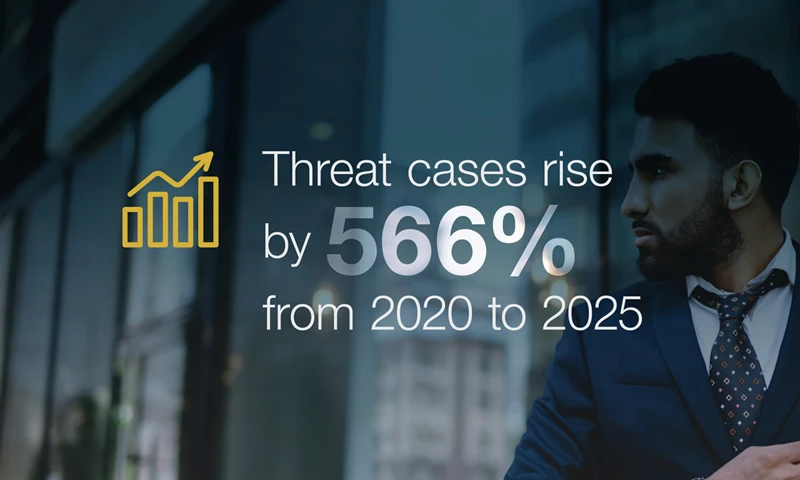
The killing of a large health insurer’s Chief Executive Officer on December 4, 2024, marked a pivotal moment for corporate security. According to the 2026 Security Executive Council's Executive Targeting Report: Analysis of Attacks on Corporate Executives from 2003-2025, attacks on corporate executives continue to rise. CEOs remain the most frequently targeted, with a growing share of incidents directed at other senior leaders. Reflecting this trend, the number of behavioral threat cases handled by Control Risks globally in 2025 was 566% higher than in 2020.
While the biggest concern is always violence against people or property, potential exposures include allegations of insufficient duty of care, reputational harm, resource strain, lack of board level oversight and financial risk. Companies are understandably reluctant to rely solely on law enforcement authorities to address critical threats. The potential consequences of a lethal attack, combined with strained policing resources and duty of care mandates, mean the client often plays an active role in assessing and managing threatening situations.
Rising ideological and grievance-driven threat
Several forces are broadening and complicating workplace violence risk:
- Grievance-driven and ideological threats. Perceived anonymity and ease of online access have lowered barriers for conveying threats, from both internal and external threat actors. Risks to executives may multiply when a company becomes associated with a controversial sociopolitical issue, and protests and activism-driven incidents are becoming more common, often accelerating alongside broader waves of grievance expression.
- Extremist ideologies and personal grievance are converging. Increasingly, violent actors draw from different ideologies or conspiracy theories and overlay them with personal grievances. Assessing the threat posed by a specific actor requires understanding rapidly changing online ecosystems, the diminishing influence of strict, hierarchical organization(s), and the central role of conspiracy in driving and sustaining most forms of violent extremism today. Our Behavior Threat Assessment and Management (BTAM) experts have studied these issues for decades and bring unique insight into recognizing when extremist threats are most likely to evolve into a violent attack.
- Internal risk is often underestimated. Control Risks’ experience, most executive protection programs are designed to address external threats. Yet many serious threats emerge from disgruntled or terminated employees. The proliferation of AI is predicted to drive an unprecedented number of job losses, a historical trigger point for workplace violence. Data also indicates a rise in the level of underlying mental health challenges complicating and compounding grievances against employers. These threats are frequently overlooked but have the potential to cause tremendous harm.
- The social media accelerant. Control Risks has seen activated individuals use chat forums to find others sharing the same grievances and to broadcast their frustrations through direct and indirect threats. The expression of violent sentiment is becoming a more normalized behavior, accelerating their progression along the pathway from grievance to action.
From reactive security to proactive prevention
Reducing the risk of violence requires organizations to move beyond reactive security measures and adopt proactive prevention strategies. Behavioral threat assessments a structured approach to identifying, assessing, and managing individuals of concern, enabling tailored interventions that reduce the likelihood of violence.
Distinguishing individuals who pose a genuine risk of violence from those who make threats without intent can be challenging. As individuals progress along the “pathway to violence”, they often exhibit observable behaviors commonly referred to as "leakage" that creates opportunities for early intervention. The objective is to recognize these behaviors and implement timely, effective intervention strategies that reduce risk and prevent violence before it occurs.
Why Control Risks is distinctive
When threats of physical harm are made against a company executive or any member of the organization, Control Risks is uniquely qualified to provide behavioral threat assessment and management advice to clients utilizing documented, defensible methodologies developed and refined by our expert consultants formerly employed in the FBI’s Behavioral Analysis Unit (BAU) to:
- Assess threats/behaviors of concern
- Develop mitigation and management strategies
- Deploy on-site to provide real-time support
Our multidisciplinary expertise is unmatched in the market and includes eight former BAU certified profilers in addition to a Forensic Psychiatrist and Forensic Psychologist, supporting our clients in preventing, identifying, assessing and managing threats of harm using formalized BTAM methodologies. These experts have over 100 years’ combined experience of assessing and managing thousands of threatening individuals and situations for private and public sector clients.
Our team of BTAM consultants is supported by further differentiators:
- Online Threat Intelligence (OTI) team. Our global in-house analysts lead open-source intelligence (OSINT) investigations to identify and monitor threats in real time. Through threat monitoring, online exposure assessments and person-of-interest (POI) products, they help assess a threat actor's intent and capability through the online lens and provide ongoing monitoring of fixated individuals in longer-term cases.
- Working alongside clients' teams. Many clients have recently designed and implemented internal workplace violence prevention and response programs, featuring BTAM teams trained to identify early warning signs and coordinate across HR, legal and security. These are valuable resources, yet some lack the additional depth of experience needed when facing potentially catastrophic threats. Our experts often participate in client BTAM meetings in support of Control Risks' threat response, sharing their knowledge in what can become a professional development opportunity for clients' teams.
- Working alongside law enforcement. With backgrounds as FBI criminal case agents, they are also adept at working in parallel with U.S. and international law enforcement, and our deep ties to the Association of Threat Assessment Professionals (ATAP) and its sister organizations across Latin America, EMEA and APAC extend that reach globally. While law enforcement will have the primary investigative and prosecutorial authority, our experts will keep a laser focus on violence prevention.
As the threat landscape broadens, the organizations that stay ahead are those that can recognize a credible threat early and act before it escalates, and that is exactly where specialist behavioral threat expertise makes the difference. For brokers, it is fast becoming part of the risk conversation clients want to have. Talk to Control Risks about how our BTAM team can support your clients in preventing, assessing and managing threats of harm.