Understanding the Evolution of Lead Regulations

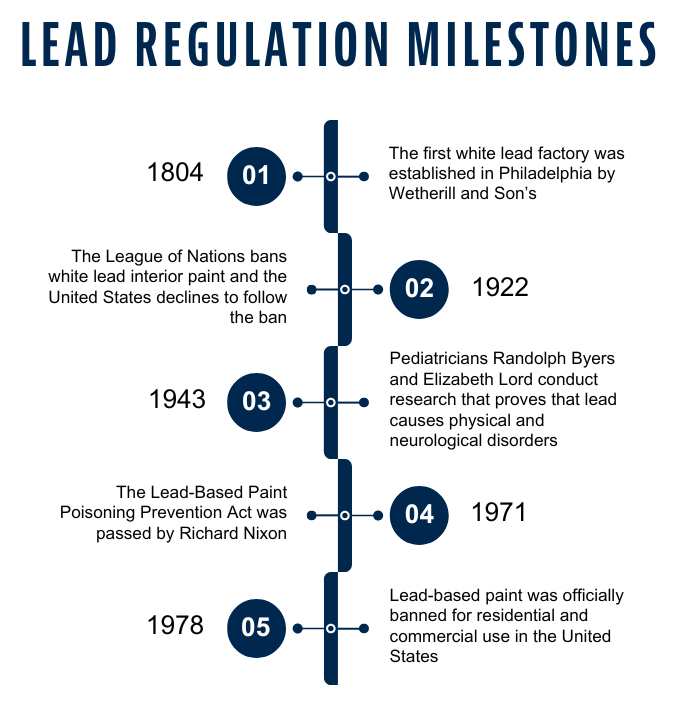
The United States widely utilized lead-based paint and other lead-containing products since the early 1800’s when the first white lead factory was established in Philadelphia1. Subsequently, lead-based paint was used in buildings due to its durability and affordability. However, over time, its use was discovered to pose significant health risks. Despite the League of Nations banning white-lead interior paint in 1922, the US did not follow suit. However, after years of research in the 1940s, studies in the US confirmed that consumption of lead caused physical and neurological disorders in children2. The studies pushed the government into action and in 1971, the Lead-Based Paint Poisoning Prevention Act was passed, and in 1978, the use of lead-based paint was prohibited for residential use, effectively stopping its use in new residential buildings1. Since then, regulations continue to change and evolve to reduce health risks associated with existing contamination found in most older buildings.
Navigating New Regulations
In November 2024, as part of a long-term continuing effort to reduce childhood lead exposure and in accordance with a 2021 US Court of Appeals opinion, the EPA published the "Reconsideration of the Dust-Lead Hazard Standards and Dust-Lead Post-Abatement Clearance Levels", which went into effect in January 2025 and requires compliance by 20263. The updated rule applies to pre-1978 homes and introduced new terminology, replacing:
- dust-lead hazard standards (DLHS) and
- dust-lead clearance levels (DLCL)
with
- dust-lead reportable levels (DLRL) and
- dust-lead action levels (DLAL)
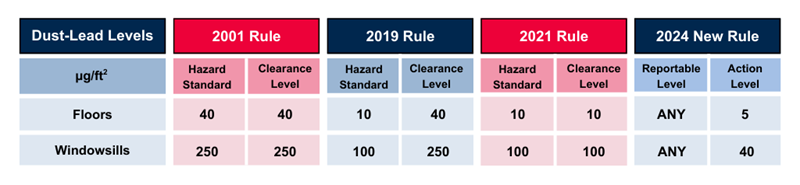
The rule sets the DLRL at “any detectable lead” meaning if detected by an EPA-approved lab on floors or windowsills, it must be reported and is now considered a reportable hazardous condition. This was done to recognize that any amount of lead exposure is not safe for children. Additionally, the DLAL for floors has been reduced from 10 micrograms per square foot (µg/ft2) to 5 µg/ft2, and for windows it has been reduced from 100 µg/ft2 to 40 µg/ft2. Action is required if these thresholds are met. This new policy went into effect on January 13, 20254.
As demonstrated in the table below, the 2024 Reconsideration Rule is a significant decrease in lead levels for windowsills and floors. For floors, the action level has been reduced by half, and for windowsills by more than half. Importantly, any EPA recognized lab detected lead results are now a reportable level3.
In addition to these reductions, if a hazard is identified, government entities such as the US Department of Housing and Urban Development, state or local agency, or tribal authorities may require landlords to pay for abatement of the property5. In addition to the USEPA, states and municipalities may have independent reporting requirements, so it is best to always check. Additionally, any contractors or firms providing lead abatement services must be certified, and post-abatement testing must ensure that dust-lead levels are below the new action levels.
Spotlight on Local Regulations
Some cities have implemented stricter regulations for lead-based paint in apartment buildings. New York City, Philadelphia, and Cleveland each have set additional lead paint regulations.
New York City, NY 'Local Law 123'6
Passed in 2023, NYC Local Law 123 is focused on pre-1960 properties:
- If a child under the age of 6 resides at a property, building owners must:
- Abate lead-based paint on door and window friction surfaces within 3 years of the child becoming a resident.
- Conduct annual notices and investigations.
- Complete repairs following city and federal regulations and hire contractors that follow prescribed safe work practices.
- Regardless of whether there are any children tenants, building owners must:
- Maintain testing records provided by contractors for 10 years and provide to the New York City Department of Housing Preservation and Development if requested
- Remove lead-based paint from doors and windows when an apartment becomes vacant.
Philadelphia, PA ‘Philadelphia Lead Disclosure & Certification Law’7
Passed in 2019, the Philadelphia lead law focuses on pre-1978 rental properties:
- As of October 1st, 2020, the Philadelphia Lead Disclosure & Certification Law requires rental units to be certified as lead-free or lead-safe even if there are no children occupying the unit.
- Apartment building owners or landlords must provide a Philadelphia Department of Public Health a Lead-Safe or Lead-Free Certificate to every tenant who has children younger than age 6 as well as dust wipe results.
- Upon every lease agreement renewal, the property owner or landlord must certify that lead disclosure law has been met.
Cleveland, OH 'Lead Safe Ordinance8
Passed in 2019, the Cleveland Lead Safe Ordinance focuses on pre-1978 properties:
- All rental property owners must provide proof their property is safe either via a Lead Safe Certification or proof of full abatement of all lead hazards.
- The Lead Safe Certification is valid for two years. After 2 years, property owners must re-apply. To receive a 20-year exemption, the property must have been fully abated or have the following:
- An onsite investigation
- A Lead Pain Inspection and Risk Assessment (LIRA)
- A surface-by-surface inspection using an X-Ray Fluorescent Instrument (XRF)
- An investigation of building age, history, and maintenance
- Environmental sampling, including dust wipe samples and soil samples
- A report of the raw data as well as the laboratory report that verifies no elevated levels of lead are present on the property
Vox, in collaboration with a Washington State Department of Health epidemiologist developed a national map9 identifying estimated lead exposure risk using census tract data on housing and poverty9. Using the map provides the medical community insights into risk areas based on the two critical factors identified, housing and poverty. The three cities (together with their surrounding suburbs) that have local lead laws discussed earlier are shown:
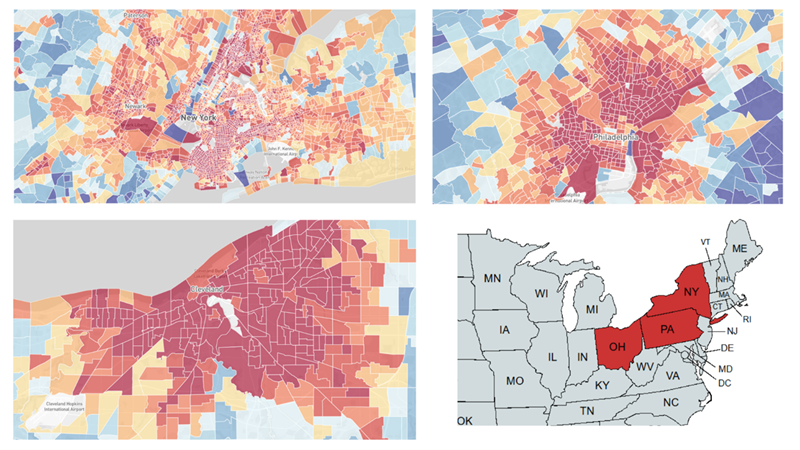
Clockwise, starting in upper left: New York City, Philadelphia, Northeast, Cleveland
By staying informed about these regulations and ensuring compliance, property owners can contribute to a safer living environment and avoid potential legal and financial repercussions.
How Can Great American Environmental Help?
Our underwriters can assist in navigating considerations for environmental insurance to help mitigate these risks for your clients. Great American Environmental is proud to offer comprehensive insurance solutions, helping keep your client’s businesses strong during a changing landscape. We provide risk control services through our in-house risk engineering team alongside a network of specialty vendors, representing diverse capabilities and experience in a variety of environmental areas. Great American can assist insured property owners in developing their own hazardous materials management plans (including lead, asbestos, mold, and more).
We offer a complete portfolio of environmental insurance products, including fixed premises pollution liability insurance products. Our core products and services help enable businesses to effectively and efficiently manage risks that can threaten their financial security.
Learn more with our Interior Risks Riskopolis!
To learn more about contaminants and environmental risks that could harm your clients’ properties and other real estate ventures, check out the Riskopolis on the right.


Megan Kennedy, Communications Intern
Great American Environmental Division
Megan Kennedy is pursuing a master’s degree in environmental science at Miami University with a bachelor’s in environmental science. Throughout her internship thus far, Megan has assisted with business development through documentation management, data cleaning, analytical support, and she contributes to organizational projects through environmental research.
- https://storymaps.arcgis.com/stories/32a2db96886c49cd9818c2cdfeefadcf
- https://archives.childrenshospital.org/a-to-z-exhibit/t-teeth/
- https://www.epa.gov/lead/hazard-standards-and-clearance-levels-lead-paint-dust-and-soil-tsca-sections-402-and-403
- https://www.federalregister.gov/documents/2024/11/12/2024-25070/reconsideration-of-the-dust-lead-hazard-standards-and-dust-lead-post-abatement-clearance-levels
- https://www.epa.gov/system/files/documents/2024-10/factsheet_final-lead-rule.pdf
- https://www.nyc.gov/site/hpd/services-and-information/lead-based-paint.page
- https://www.phila.gov/media/20210223163151/Landlord-Guidance_Oct_2020_2_23_21.pdf
- https://www.clevelandohio.gov/sites/clevelandohio/files/Building%20and%20Housing/Lead-Safe-Certification-Technical-Guidance1024.pdf
- https://www.vox.com/a/lead-exposure-risk-map