CLAIMS
Claims Service and Expertise
When you need to make a claim, you want to work with experts who understand your loss and what to do. That’s why at Great American, our claims professionals specialize in the markets they serve. We'll pair you with claims professionals who have deep industry experience and understand your organization’s specific needs.

A Guide for Your Claims Reporting Experience
Our claims professionals stand ready to help when the unexpected happens. Watch this short video to understand the multiple ways you can report a claim to help ease your experience as you navigate the claims process.

Specialty Claim: Expertise When It Matters Most
When it comes to making a claim, you deserve experts who truly understand your industry and share your priorities. Discover how our dedicated Claims teams bring deep industry-specific expertise to support you when you need it most.

SIU: Keeping the Promise
Your business's unique risks require specialized support. When you buy insurance, you're buying the promise that we can meet our obligations to you. Discover how our Special Investigation Unit (SIU) helps ensure we keep that promise, even when the unthinkable happens.

Expert Claims for Your Cyber Event
A cyber event is one of the most pressing things a business owner can face, with the potential for both legal and financial ramifications. Discover how we work collaboratively with our insureds and vendor response team to help restore your environment.

Workers' Comp: Data & People Make the Difference
By using data-driven insights, our skilled claim professionals can select providers focused on quality care. This helps injured workers recover and delivers superior outcomes for both workers and insured clients.
What do I need to report a claim?
-
Your Name
-
Your contact information (address, phone number and email)
-
Your connection to the claim (For example, are you the policyholder, the agent, an injured party or a witness?)
-
A Great American policy number (as available)
-
The type of loss – auto, property, workers comp, general liability
-
Details of what happened
Report a claim
Other Contacts
Workers' Compensation Claims
Electronic Billing Information
Medical providers can submit bills directly through the Data Dimensions electronic billing system. If you have questions, contact Data Dimensions.
Claims Payments Via Electronic Funds Transfer
To receive Workers' Compensation claims payments electronically, complete this form, and email or mail it to our offices (as noted on the form).
Not sure where to go?
If you're not sure how to proceed, contact our Call Center team.
844 GAIG NOW (844-424-4669)
Option 1: new claims
Option 2: existing claims.
Please call during our regular business hours of 8:00 a.m.-5:00 p.m. Eastern.
Additional Resources
Our claims professionals specialize in the markets they serve.
Marina Fire Safety: Preventing Marina Fires and Protecting Boats, Guests and Property
As boating seasons become busier and marinas store, service and support an increasing variety of vessels, the risk of a marina fire remains one of the most significant hazards facing marina operators and boat owners. A marina fire can start from many sources—including electrical systems, lithium-ion battery failures, vessel engines, fueling docks, shore power equipment and hot work—and once started, fire can spread rapidly across docks, structures and boats, potentially causing catastrophic losses in minutes.
Whether you operate a marina, own a boat or do both, understanding the leading causes of marina fires and how to prevent them is essential to protecting people, property and operations. The guidance below highlights key marina fire exposures and practical steps that:
For role-specific guidance, read our Marina Fire Safety for Marina Operators and Marina Fire Safety for Boat Owners.
- Marina operators can take through facility design, policies and maintenance; and
- Boat owners can take through day-to-day decisions, routine checks and communication with their marina.
Fire Suppression Systems and Emergency Preparedness
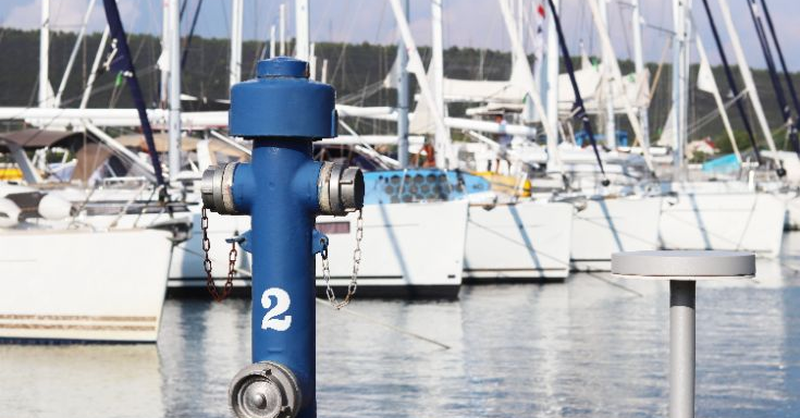
Effective marina fire response depends on the right systems, planning and training—before an emergency occurs. Marina fire safety programs should address detection, suppression, access to firefighting water supplies and clear emergency procedures for staff and tenants.
Emergency Response Pre-Planning and Coordination with External Resources
Well-designed emergency response plans help marina operators and boat owners respond quickly and consistently when a marina fire or related emergency occurs. A clear plan outlines who does what, how to notify emergency services, how to evacuate people, and how to support responding agencies and service providers.
Thermal Runaway: Lithium-Ion Battery Hazards in Storage Areas
Lithium-ion batteries continue to grow in popularity for vessel propulsion, electric outboards and onshore equipment. But with their convenience comes the risk of thermal runaway, a chain reaction where internal cell failures cause rapid overheating, gas release and ignition.
Battery Storage, Charging Stations and Shore Power Safety
Beyond lithium-ion hazards, marinas rely heavily on battery banks, chargers, forklifts, carts and maintenance tools, all of which can increase marina fire exposure if not properly managed. Shore power systems are especially vulnerable to moisture, corrosion and high electrical loads.
Electrical Fires in Marina Buildings and Shore Power Equipment
Electrical malfunctions remain a top marina fire source in marina buildings, workshops and dock pedestals. Exposure to moisture, corrosion and high loads makes shore power equipment especially vulnerable.
Engine and Vessel Fires
Fuel leaks, overheated engines and neglected maintenance increase the likelihood of vessel fires, whether boats are docked, under repair or underway. A vessel fire can quickly become a marina fire when flames spread to adjacent boats and dock structures.
Fueling Dock Fires
Fueling activities are among the highest-risk operations in any marina. Gasoline vapors are highly flammable and can travel across decks and water surfaces, where they may encounter ignition sources.
Hot Work Fires in Maintenance Areas
Welding, grinding, soldering and cutting can produce sparks and hot surfaces capable of igniting combustible materials even after work has ended. Hot work is a common source of marina fires when controls and fire watches are not in place.
Protect Your Marina. Protect Your Community.
Marina fire risks are diverse, fast-moving and often preventable. With thoughtful inspection, training, equipment maintenance and hazard awareness—especially regarding emerging exposures like lithium-ion thermal runaway—marina operators and boat owners can work together to reduce the likelihood of a marina fire and limit its impact if one occurs.
Related Articles
Frequently Asked Questions (FAQ)
Common marina fire causes include electrical failures in shore power or dock pedestals, improper battery charging or lithium-ion thermal runaway, vessel engine or fuel system leaks, fueling dock vapor ignition and hot work sparks in maintenance areas.
Start with inspection and maintenance of shore power equipment, strengthen fueling and hot work policies, improve housekeeping around charging and maintenance areas, and implement a written emergency response plan with drills and coordination with the local fire department.
Yes. Lithium-ion batteries can fail and enter thermal runaway, producing heat, flammable gases and fire. Dedicated storage/charging controls, monitoring and clear policies for damaged batteries help reduce risk.
Boat owners should maintain engines and fuel systems, keep bilges clean, use shore power safely (and replace damaged cords), follow marina fueling rules, and report unusual heat, arcing, odors or smoke to marina staff immediately.
Many marinas reference NFPA standards such as NFPA 303 and NFPA 306 for fire safety and the National Electrical Code (NEC) Article 555 for marina and boatyard electrical requirements. Local codes and AHJ requirements should also be followed.
- Fire Safety & Property Protection
- Workplace Safety
- Loss Control
- Ocean Marine