Beyond California: What SB 253 and SB 261 Mean for Brokers and Insureds

California has long played a significant role in shaping the environmental regulation landscape. Due to the size of its economy and the number of businesses that operate within the state, California regulatory developments frequently affect organizations located far beyond its borders. For brokers working with companies that do business in California, understanding environmental requirements can help identify potential compliance obligations before they catch insureds by surprise.
A recent and evolving example of these potential compliance obligations is the California Climate Accountability Package, consisting of Senate Bill (SB) 253 and SB 261. These laws establish greenhouse gas emissions reporting and climate-related financial risk disclosure requirements for entities over certain annual revenue thresholds doing business in California. With revenue thresholds in mind, these disclosure requirements are not limited to companies headquartered in California, creating compliance obligations that extend beyond state borders.
Understanding the Climate Accountability Package
SB 253: Reporting Greenhouse Gas Emissions
SB 253 requires affected entities to report their greenhouse gas emissions annually to the California Air Resources Board (CARB). The law applies to U.S.-based entities with annual revenues exceeding $1 billion that do business in California.1 Reporting entities must disclose Scope 1 and Scope 2 emissions by the 2026 deadline set by the state board, and begin reporting Scope 3 emissions in 2027.2
For many organizations, Scope 3 reporting may present the greatest challenge to track. This is because these emissions from suppliers, transportation, product use, and all other parts of the value chain are counted, even if they are indirectly emitted.3 As a result, compliance may therefore extend beyond environmental reporting to include data collection, governance and documentation processes that reach across the organization.
SB 261: Climate-Related Financial Risk Act
While SB 253 focuses on disclosure of greenhouse gas emissions, SB 261 focuses on climate-related financial risk. The law applies to U.S.-based entities with annual revenues exceeding $500 million that do business in California and requires covered organizations to evaluate and disclose material climate-related financial risks and the measures used to adapt to those risks.4
Current Regulatory and Legal Developments
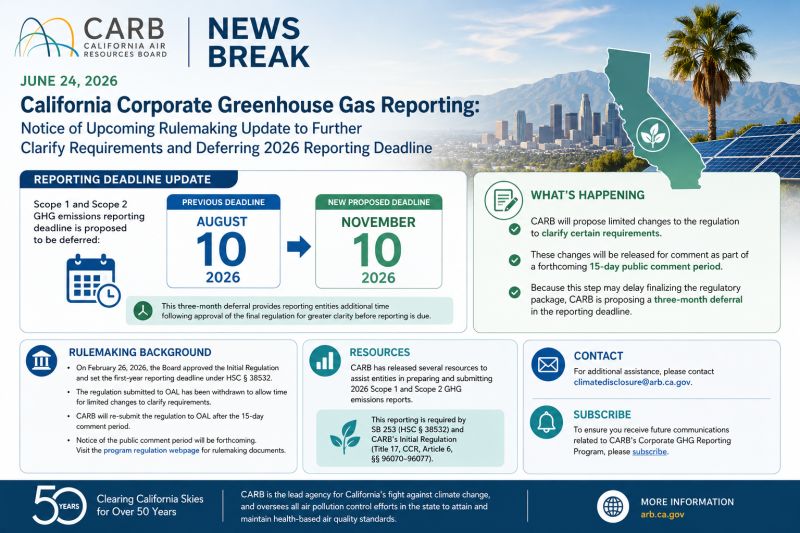
Although both laws were signed as part of California’s Climate Accountability package, implementation has followed different paths. SB 253 continues to advance via CARB’s rulemaking process. In February 2026, the state board approved initial regulations establishing reporting requirements for covered entities. Following stakeholder feedback and additional regulatory revisions, CARB subsequently delayed the first Scope 1 and Scope 2 reporting deadline from Aug. 10, 2026, to Nov. 10, 2026, to provide additional time for final regulatory clarification.5 CARB has also indicated that additional guidance and requirements will be developed for future reporting years, including Scope 3 emissions reporting and assurance requirements.
SB 261 faces greater uncertainty. In November 2025, the U.S. Court of Appeals for the Ninth Circuit issued an injunction halting enforcement while litigation proceeds. As a result, California has suspended enforcement of the original reporting deadline pending the appellate proceedings. Although SB 261 remains the law, its future implementation timeline remains dependent upon the litigation's outcome.
Why This Matters for Brokers and Insureds
Although SB 253 and 261 are not insurance regulations, they may create new compliance, governance and reporting obligations for affected organizations. Companies subject to these requirements would need to establish emissions reporting programs, evaluate climate-related risks, and develop internal processes to support future disclosures.
For brokers, the significance lies in identifying insureds that may be affected. Because the laws apply to all companies that do business in California rather than only those headquartered there, some organizations may not immediately recognize that they fall within the scope of these requirements. Understanding the applicable thresholds and current implementation status can help support more informed discussions with clients regarding environmental compliance and emerging regulatory obligations.
How Great American Environmental Division Can Help
Great American Environmental Division works closely with brokers and insureds to navigate an increasingly complex environmental regulatory landscape. In addition to providing environmental insurance solutions, our underwriting and risk engineering teams monitor emerging environmental developments that may affect insureds’ operations and risk profiles. As climate disclosure requirements continue to evolve, awareness of changing regulations can help businesses better understand their obligations and prepare for future compliance challenges. California’s Climate Accountability Package has moved from a legislative proposal to active implementation. While significant questions remain regarding future rulemaking and ongoing litigation, affected organizations doing business in California may already be subject to new reporting and disclosure requirements. For brokers serving clients with California operations, understanding the applicability and status of SB 253 and SB 261 can help support informed conversations around environmental compliance, risk management and emerging regulatory obligations.

Laura Coca, Production Underwriter
Great American Environmental Division
Lauren Coca is a Production Underwriter with Great American’s Environmental Division. In her role, Lauren evaluates risk profiles to provide innovative insurance solutions to insureds across a variety of industries while collaborating with a diverse team of industry professionals. She is based out of our Exton, Pa., main office.

Leah Bahn, Communications Intern
Great American Environmental Division
Leah Bahn is a senior at Elon University, pursuing a bachelor’s degree in environmental and sustainability studies and public policy with a minor in business administration. During her internship with the Environmental Division, Leah has supported business development, industry research and marketing initiatives, including conference planning, environmental research and content development.
- California Corporate Greenhouse Gas (GHG) Reporting and Climate Related Financial Risk Disclosure Programs
- Bill Text - SB-253 Climate Corporate Data Accountability Act
- Supply chain sustainability: Top ways firms track Scope 3 emissions
- The Ninth Circuit Stays Enforcement of SB 261 | Wilson Sonsini
- SB 253 Update: CARB Delays Reporting Deadline to November 2026 and Proposes to Clarify Requirements | Sidley Environmental, Health, and Safety Brief